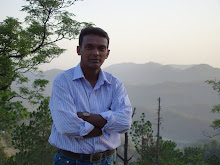
EK PEHCHAN HU MAI
NISHABDH HO KE GHAV SAHY SAKTA HU MAI
SHANT REH KE BHI LAR SAKTA HU MAI
KHALI HATH SATRUNASH KAR SAKTA HU MAI
EK HI BARI MEI APNA SAB KUCH CHOR SAKTA HU MAI
PICHE MUR KE BHI NA DEKHUNGA
ANSOO KI EK BUNDH BHI NEHI NIKALUNGA
HAZAR HAR KE BAD BHI JEET KE HI SACHUNGA
SAB GAWA KAR BHI DOST KA SATH NA CHARUNGA
EK PEHCHAN HU MAI
RUDRANEEL
Tuesday, June 23, 2009


Wednesday, June 10, 2009
nupur
NUPUR
ROILO AAJIBON SE PAYER KACHHE PORE
BADYOJONTRER PORICHITI DEY NI KEU TARE
SUDDHU TARE NIYE KORENI KEU NAAM DAAK
OBEHELAY ROILO PORE SOBAR THEKE JEN DURE THAAK
TALER SATHHE AAOWAJ KORE MOTTO KORE NIMESHE
TABOU DARSHOKER BAHBA KODALO NA NIJE SE
PORDAR ANTORALE KHULE REKHHE JAY SOBAI TARE
TOBUO CHIROKAAL BEDHHEE RAKHTE CHAI TARE NIJO GHORE
KOTOKAL PORE AAJ SEI PROTIKHON ELO
NIJERI OJANTE PROTHOM DEKHA HOLO
SHOTO MANUSHER BHIRE SOBAR NOJOR KARE
ALTO HAWAY KHOLA CHUL BATASHHE JENO ORE
NIL CHURIDAR SIDUR LOLATE LOMBA DUL KANE
PROTHOM SURJOKIRON TOMAR KACHE SOTTI HAR MANE
APURBO TOMAR HASHHI TUMI APURUP SUNDORI
ECHHE HOY ALTO KORE TOMAY SPORSO KORI
---- AMAR NUPUR
-----RUDRANEEL
Friday, December 26, 2008
“GARHWALIS IN INDIAN NATIONAL ARMY”
“GARHWALIS IN INDIAN NATIONAL ARMY”
RUDRANEEL
Introduction
The Indian National Army (INA) or Azad Hind Fauj (Hindi: आज़ाद हिन्द फ़ौज, AFH) was an armed force formed by Indian nationalists in 1942 in South east Asia during World War II. The aim of the army was to overthrow the British Raj in colonial India, with Japanese assistance. Initially composed of Indian prisoners of war captured by Japan in her Malayan campaign and at Singapore, it later drew large numbers of volunteers from Indian expatriate population in Malaya and Burma. Initially formed in 1942 immediately after the fall of Singapore under Capt Mohan Singh, the first INA collapsed in December that year before it was revived under the leadership of Subhas Chandra Bose in 1943 and proclaimed the army of Bose's Arzi Hukumat-e-Azad Hind (The Provisional Government of Free India). This second INA fought along with the Imperial Japanese Army against the British and commonwealth forces in the campaigns in Burma, Imphal and Kohima, and later, against the successful Burma Campaign of the allies. The end of the war saw a large number of the troops repatriated to India where some faced trial for treason and became a galvanising point of the Indian Independence movement. After Indian independence, the ex-INA members, with some exceptions, were refused service in the Indian Army. However, a number of notable members later became involved in public life in India and in South East Asia.
In the world history World War II marks the watershed for emergence of Nationalism & fall of Imperialism. It is debatable as to why the heroes of INA were tried even in post independence era? Could be the fading British Imperialism still carried enough sting to charge them with treason for having joined hands with INA after having been taken as POWs. Could be the Indian judiciary, still in its infancy, was overridden by the so called British imperial laws whereby the INA persons were tried by the military court or could be passion for non violent means to gain independence pushed the efforts of those gallant soldiers to obscurity. The Allied’s defeat in far east could be termed as a major pitfall in British leadership. The deeds of those devoted unsung soldiers cannot go unnoticed. Their contribution towards Indian struggle for independence yearns a justified place in the Indian history.
Combined Battalion 18th Royal Garhwal Rifles (
On the evening of
On 10th of February 1942 the battalion was ordered to withdraw ‘D’ Company under Captain Chander Singh Negi however lost touch with the Battalion Head Quarter. Unconfirmed report talk about him being sighted at
On
In the book “The Forgotten Army” India’s Armed struggle for Independence 1942-45 by Peter Ward Fay Pg 137 clearly brought out that soldiers of Garhwal Rifles, The 3/17th Dogras and The combined 1/14th and 5/14th Punjab Regiment joined INA. All these men were under Lt Col JK Bhonsle’s Hindustan Field Force.
The Rise of New Leadership
On
On
At National Archives of India New Delhi, one can easily find names of as many as 160 to 170 Garhwali Officers which include Maj Padam Singh Gusain, Capt Mahinder Singh Bagri, 2Lt Gain Singh Bisht, Capt SS Yadav, Capt NS Negi, Capt Chander Singh Negi and many other Officers who were promoted from the ranks. There are 1050 Garhwali pensioners of INA whose documents are maintained in Records, The Garhwal Rifles.
Exploits of Garhwali as part of INA
The main body of No 1 Regiment, Subhas Brigade covered a distance of over 400 miles in 5 weeks on foot and reached
On
During this period, Capt Ram Singh Thakuri gave the musical tune of the famous marching song of the Azad Hind Fauj- “Kadam Kadam badaye ja, Khusi ke geet gaye ja.” This song has not only inspired the Azad Hind Fauj but also millions of Indians. This song has now been adopted by Indian Army as “Army Song”.
On
The dare devil action of Lt Gian Singh Bisht (Ex-2/18 RGR) at Taungzin on 16 Mar 1945 was recorded and submitted as an exhibit during the Red Fort Trial by his Brigade Commander, Col GS Dhillon. Col GS Dhillon signed the report on
“Lt Gian Singh Bisht had been trained at the Officer’s Training School of the Azad Hind Fauj and commanded a company of 98 strong. They had rifles as the only weapon of defence or offense. Their orders were to check the enemy’s advance at any cost. It was a flat stretch of land with out any cover except a shallow dry pond near which three tactically significant roads. On
By May –Jun 1945, AHF resistance had petered down. With the rush of the Allied forces in
Conclusion
Garhwali Bhullas are well known for their gallantry honesty integrity and allegiance. The brave Bhullas gave a true account of their simplicity, honesty and martial characteristics whether as part of British Indian Army or Indian National Army of Subhas Chandra Bose. They continue to deliver as part of Indian Army of today as well. It is unfortunate for reasons unknown, the gallant bhullas of Garhwal Rifles, who braved through extreme odd far away from their homeland, had to bear will the anonymity even in post colonial ere. It is time now at least, that we acknowledge the faithfulness and gallantry of those unsung heroes. Lest not forget them.
Jai Hind
Jai Badri Vishal
References
1. Wikipedia.web
2. War Diary of Major Harold Nesham
3. Regimental History Vol II of The Garhwal Rifles
4. “The Forgotten Army”
5. My moments of INA & its Netaji by Maj Gen Shah Nawaz Khan (INA)
6. Col GS Dhillon’s “From my Bones”
7. Ami Subhas Bolchi.- (Bengali)
IS RISHTEY KA KYA NAAM DU
IS RISHTEY KA KYA NAAM DU
Is rishtey ka kya naam du
Jis ko khol ke maai bol na pau
Puchhu jisse wo kahte haai do pal ki cahhat
Lekin kisine samjhaya mujhe pyar ki taqat
Chillake bol na chatahu nile gagan ke niche
Lekin phir bhi darta hoo koi sun na le mujhe
Dhire se maine bola dil me khudke
Behsumar pyar haai mujhe tumse
Aankh bhar ate lekin asu ki ek bundh na nikle
Dil hi dil me roh raha hu hamare risteko soch ke
Koi kuch bhi kahde mujhe
Chor na paunga zindegi me kabhi tujhhe
Jabbhi kabhi dil bharak aye to dekhna murke
Tumhare pichhe hamesha aah raha hoo maai chalke
RUDRANEEL
IS RISHTEY KA KYA NAAM DU
IS RISHTEY KA KYA NAAM DU
Is rishtey ka kya naam du
Jis ko khol ke maai bol na pau
Puchhu jisse wo kahte haai do pal ki cahhat
Lekin kisine samjhaya mujhe pyar ki taqat
Chillake bol na chatahu nile gagan ke niche
Lekin phir bhi darta hoo koi sun na le mujhe
Dhire se maine bola dil me khudke
Behsumar pyar haai mujhe tumse
Aankh bhar ate lekin asu ki ek bundh na nikle
Dil hi dil me roh raha hu hamare risteko soch ke
Koi kuch bhi kahde mujhe
Chor na paunga zindegi me kabhi tujhhe
Jabbhi kabhi dil bharak aye to dekhna murke
Tumhare pichhe hamesha aah raha hoo maai chalke
RUDRANEEL
Subscribe to:
Posts (Atom)